

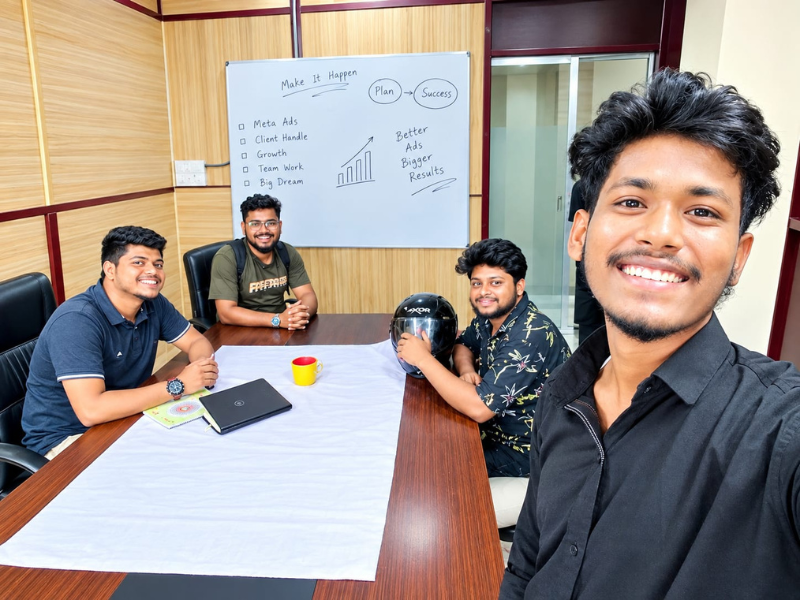
Important business meeting with the owner of Comarsia Shipping.
Today’s meetup was not merely a routine meeting; it was a significant discussion regarding future business growth, strategic marketing, high-budget advertising planning, and long-term expansion. Taking a business from a small scale to a larger level requires more than just a quality product or service—it demands proper planning, the right marketing strategy, data-driven decision-making, efficient execution, and a long-term vision. We held a detailed discussion with the owner of Comarsia Shipping with these very factors in mind.
Business competition today is fiercer than ever before. Simply having a Facebook page or a website is no longer enough to reach customers. One must strategically analyze every aspect: where customers are coming from, what content they respond to, which audience segments are most interested, which campaigns generate qualified leads, where demand is highest, how to allocate budgets across platforms, and how to generate a sustainable return on marketing investment. Therefore, before launching a high-budget marketing campaign, planning is our top priority.
During this meetup, we discussed the business’s current standing, future goals, potential customer base, marketing opportunities, and avenues for expansion. Our objective was to craft a marketing strategy where the goal isn’t just to run ads, but to ensure every marketing activity is linked to a specific business objective. Advertising is only effective when it is properly aligned with the business’s overall growth.
Step 1 — Planning
The first step is proper planning. Before embarking on any major marketing investment, we must understand where we stand and where we want to go. It is essential to create a clear roadmap by analyzing current business performance, target customers, service areas, competition, existing marketing channels, and growth potential.
A large budget implies more than just high ad spending; it also entails significant responsibility. Strategic decisions must be made in advance regarding budget allocation, campaign launch sequences, target audience segments, creative assets, and the duration of the testing period.
Step 2 — Audience & Market Analysis
Selecting the right audience is a crucial component of a successful marketing campaign. Instead of targeting everyone, we need to identify the audience that is genuinely interested in the business’s products or services and has the potential to become customers.
Marketing strategies can be refined by analyzing data such as audience location, age group, interests, online behavior, purchasing intent, and previous interactions. Simultaneously, identifying which customer segments within the market are most valuable—and which hold the greatest potential for future growth—is a vital part of our planning process.
Step 3 — Digital Marketing Strategy
In today’s digital era, various marketing channels can work in tandem to drive business growth. Channels such as Meta Ads, Google Ads, SEO, Content Marketing, Social Media Marketing, Retargeting, and Website Optimization each play a distinct role.
Therefore, our approach focuses on an integrated digital marketing strategy rather than relying on a single platform. This involves connecting various platforms to create opportunities to reach potential customers at different stages of their journey.
Step 4 — Campaign Structure
Managing a high-budget marketing campaign without a professional structure can be risky. Key elements—such as campaign objectives, audience structure, creative testing, budget allocation, and conversion tracking—must be properly set up.
Initially, the performance of different audiences and creatives can be evaluated through testing. Subsequently, plans can be made to scale the budget based on the campaigns or audiences that yield the best data. This allows marketing investments to be driven by data rather than blind budget increases.
Step 5 — Creative & Branding
Targeting alone is not enough for a successful marketing campaign; capturing customer attention requires strong creative elements, clear communication, and consistent branding.
Customers often decide within the first few seconds whether or not to engage further with the content. Therefore, every aspect—including creative design, copywriting, visual presentation, brand messaging, and the call-to-action—must be crafted with care.
Maintaining consistency in branding is equally important. Maintaining a consistent brand identity across the website, Facebook page, advertisements, content, and other digital touchpoints allows a business to appear more professional and recognizable to customers.
Step 6 — Tracking & Data
Tracking is one of the most critical aspects of marketing. Without data—such as where traffic originates, which audiences engage the most, which ads generate leads or conversions, and where drop-offs occur in the customer journey—it is difficult to optimize a marketing strategy.
Proper implementation of pixels or conversion tracking, event setup, website analytics, and campaign reporting allows for a clearer analysis of marketing performance. Subsequently, this data can be used to identify campaign weaknesses and implement optimizations.
Step 7 — Execution
No matter how good the planning is, no strategy can be successfully implemented without proper execution. Therefore, structured execution is essential after the planning phase.
Every step—from campaign launch to creative testing, audience monitoring, budget management, performance analysis, retargeting, and regular optimization—needs to be managed through a defined process.
To us, execution means more than just launching a campaign and waiting. Analyzing data regularly after the launch, making necessary adjustments, and identifying new opportunities are also crucial components of execution.
Step 8 — Optimization & Scaling
If a campaign performs well, there is no room to simply stop there. Instead, the next question is how to scale that performance further.
When scaling, rather than drastically increasing the budget all at once, it is necessary to scale step-by-step while considering performance data, costs, conversion quality, and audience capacity. Simultaneously, growth opportunities can be created by testing new audiences, creatives, and campaign structures.
Step 9 — Retargeting
Not all customers make a decision the moment they see an advertisement. Many potential customers might visit the website, interact with the page, or learn about the product/service without converting immediately.
Retargeting can be a vital strategy for this audience. By specifically targeting previous visitors, engaged users, and other relevant audience segments, one can create opportunities to reconnect them with the business.
Step 10 — Long-Term Growth
Long-term growth was one of the most important topics of our discussion. This is because a business’s goal is not merely about today’s sales or leads, but about building a sustainable brand for the future.
Through a combination of a strong digital presence, consistent marketing, customer trust, data-driven decision-making, and continuous optimization, a business can move to a much stronger position in the long run.
Budget • Plan • Execution • Optimization • Growth
A large budget becomes meaningful only when utilized under a clear strategy. Therefore, our approach is to first understand business goals, analyze the market, develop audience and campaign strategies, execute in a structured manner, and finally, optimize and scale based on data.
At this meetup, we also discussed future expansion in detail. When a business reaches a certain stage, it becomes necessary to consider new markets, customer segments, service areas, and digital channels. It is also crucial to ensure that every step of expansion aligns with the business’s capacity and long-term goals.
We believe that business growth is not a one-time task; it is a continuous process. A decision made today can lay the foundation for future growth. Therefore, every step should be backed by research, data, strategy, and a clear vision.
In this important discussion with the owner of Comarsia Shipping, we explored how to transition from the current business standing to future possibilities, make marketing investments more strategic, and build a sustainable growth system.
When a business moves forward with a grand vision, its marketing strategy must align with that vision. Whether the budget is small or large, there should be a clear purpose behind where and why every penny is spent.
Our work goes beyond merely running advertisements. Our goal is to understand the business objectives and craft a comprehensive digital marketing strategy—integrating everything from planning to execution, data to optimization, and marketing to actual business growth into a unified process.
Today’s meetup represents another significant strategic discussion for us. We look forward to working on future planning, analysis, and new growth opportunities.
Step-by-Step Planning → Smart Execution → Data-Driven Optimization → Sustainable Growth
The goal is singular: sound planning, smart decisions, effective marketing, and long-term business growth.
Budget • Plan • Bigger Vision
Friends IT Agency ➡️ Comarsia Shipping
Digital marketing is more than just advertising; our mission is to shape a business’s growth journey through the right strategy.